

Corporate learning and development professionals face a critical challenge: proving training impact through accurate progress tracking. Without robust measurement systems, you cannot demonstrate ROI, align programs with business objectives, or optimize employee development initiatives. This guide presents a comprehensive framework for mastering learning progress tracking, from strategic alignment and evaluation models to AI-powered tools and proven best practices that transform L&D measurement into a competitive advantage.
Table of Contents
- Understanding The Foundation: Aligning Learning Progress With Business Goals
- Applying The Kirkpatrick Model To Measure Learning Progress Effectively
- Leveraging AI And LMS Platforms To Enhance Learning Progress Tracking
- Best Practices And Common Pitfalls In Tracking Employee Learning Progress
- Optimize Your Learning Progress Tracking With DigitalEdu Solutions
Key takeaways
| Point | Details |
|---|---|
| Align metrics with business KPIs | Connect learning outcomes directly to organizational performance indicators for measurable impact. |
| Apply structured evaluation frameworks | Use proven models like Kirkpatrick to systematically assess progress across multiple dimensions. |
| Leverage AI and LMS platforms | Automate tracking, personalize pathways, and gain real-time insights through intelligent technology. |
| Implement consistent analysis cycles | Regular data review enables continuous improvement and validates training effectiveness. |
| Avoid common tracking pitfalls | Prevent measurement failures by addressing learner feedback and maintaining metric alignment. |
Understanding the foundation: Aligning learning progress with business goals
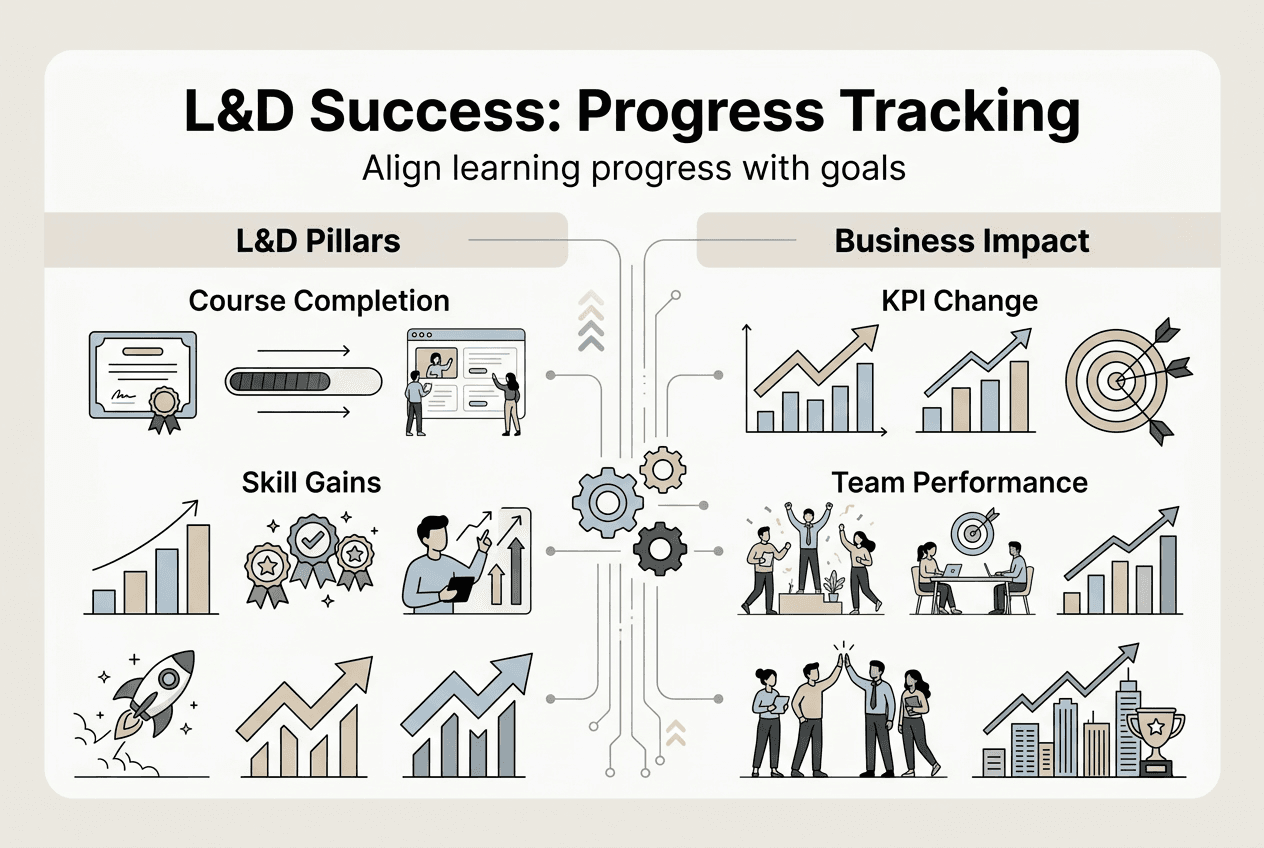
Effective learning progress tracking begins with strategic alignment between L&D initiatives and corporate objectives. Strategic alignment is crucial for building a solid L&D strategy that delivers measurable business value. When you connect learning metrics to performance indicators, training transforms from a cost center into a growth driver. This foundational approach ensures every tracked metric supports organizational priorities and demonstrates tangible returns.
Aligning learning metrics with business KPIs requires identifying which competencies directly impact revenue, productivity, customer satisfaction, and retention. Skills gap analysis reveals these critical competencies by comparing current workforce capabilities against strategic requirements. Once gaps are mapped, you can design personalized learning pathways that address specific deficiencies while tracking progress toward closing those gaps. This targeted approach maximizes both learner engagement and business impact.
Several prerequisites enable effective progress tracking in corporate L&D environments:
- Clear learning objectives tied to measurable business outcomes
- Baseline assessments establishing current competency levels
- Defined success metrics for each training initiative
- Technology infrastructure supporting data collection and analysis
- Stakeholder buy-in from leadership and learners
When you establish these foundational elements, aligning L&D strategies becomes systematic rather than aspirational. Learners understand how their development connects to career advancement and organizational success, boosting engagement rates. Executives see concrete evidence of training ROI through metrics that mirror their strategic dashboards. This alignment creates a virtuous cycle where successful outcomes justify continued investment, enabling more sophisticated tracking capabilities over time.
Pro Tip: Start small by aligning one high-impact training program with a single business KPI, then expand your tracking framework as you demonstrate early wins and build organizational confidence.
Applying the Kirkpatrick model to measure learning progress effectively
The Kirkpatrick Model provides structured evaluation across four progressive levels, offering a comprehensive framework for measuring learning impact. This proven methodology helps L&D professionals systematically track progress from initial reactions through behavioral change and business results. Understanding each level enables you to select appropriate measurement tools and interpret data within the proper context.
Level 2 evaluations, focused on actual learning gains, provide the most direct evidence of knowledge and skill acquisition. Pre-training and post-training assessments establish baseline competencies and quantify improvement, creating objective progress metrics. Assignments and projects demonstrate practical application, revealing whether learners can transfer knowledge to real-world scenarios. Feedback surveys capture learner perceptions about content relevance and delivery effectiveness, informing iterative improvements.
| Evaluation Level | Primary Focus | Key Tracking Methods |
|---|---|---|
| Level 1: Reaction | Learner satisfaction and engagement | Surveys, feedback forms, participation rates |
| Level 2: Learning | Knowledge and skill acquisition | Pre/post-tests, assignments, projects, certifications |
| Level 3: Behavior | On-the-job application and performance | Observations, manager assessments, performance metrics |
| Level 4: Results | Business impact and ROI | KPI changes, revenue impact, cost savings, retention |
Implementing Level 2 evaluations requires careful design to maximize insights while minimizing disruption. Create assessments that mirror actual job tasks rather than testing rote memorization. Use varied question types including scenario-based problems that reveal critical thinking and application skills. Schedule post-tests strategically, allowing time for knowledge consolidation but avoiding delays that permit skill decay. Analyze results at both individual and cohort levels to identify learning patterns and content gaps.
These measurement methods feed directly into continuous improvement cycles by revealing which content resonates, which delivery methods work best, and where learners struggle. When you combine Level 2 data with Kirkpatrick model evaluation at other levels, you build a complete picture of training effectiveness. This multi-dimensional view enables precise interventions, whether adjusting content difficulty, modifying delivery formats, or providing targeted support to struggling learners.
Pro Tip: Automate Level 2 assessments within your LMS to reduce administrative burden and capture data consistently across all programs, enabling meaningful comparisons over time.
Leveraging AI and LMS platforms to enhance learning progress tracking
Artificial intelligence revolutionizes learning progress tracking through personalization, automation, and predictive analytics that were impossible with manual systems. AI integration resulted in 15-30% improvements in training efficiency across diverse organizations, demonstrating tangible ROI from intelligent learning technologies. These systems analyze learner behavior patterns, adapt content delivery, and surface insights that help L&D professionals optimize programs in real time.
AI-powered tracking delivers three transformative benefits for corporate learning:
- Personalization at scale through adaptive learning paths matching individual needs and pace
- Efficiency gains via automated assessment grading, progress monitoring, and intervention triggers
- Scalability enabling consistent tracking across thousands of learners without proportional resource increases
Learning Management Systems provide the infrastructure for centralized progress management, consolidating data from multiple sources into unified dashboards. Adobe Learning Manager enables organizations to deliver, manage, and track training effectively while demonstrating measurable business impact. Modern LMS platforms integrate AI capabilities, combining human-designed curricula with machine intelligence that personalizes delivery and predicts outcomes.

| AI Impact Metric | Improvement Range | Business Outcome |
|---|---|---|
| Training efficiency | 15-30% | Reduced time to competency, lower costs per learner |
| Employee retention | 12-25% | Decreased turnover through enhanced engagement and development |
| Completion rates | 20-40% | Higher ROI from training investments, better skill coverage |
| Learning personalization | 3-5x | Improved relevance, faster skill acquisition, greater satisfaction |
Selecting the right AI in corporate training tools requires evaluating integration capabilities, data security, and alignment with existing workflows. Prioritize platforms offering robust APIs that connect with your HRIS, performance management systems, and business intelligence tools. Ensure the solution provides granular privacy controls and complies with data protection regulations relevant to your industry and geography. Test user interfaces with actual learners and administrators to verify intuitive navigation and actionable reporting.
Maximizing LMS tracking features involves configuring automated alerts for at-risk learners, establishing milestone-based progress gates, and creating custom reports that surface actionable insights. Use AI evaluation in L&D to identify which learners would benefit from additional support before they fall behind. Leverage predictive analytics to forecast completion rates and adjust resource allocation proactively. Integrate tracking data with performance reviews to reinforce the connection between learning and career advancement.
Explore DigitalEdu learning services to see how AI-enhanced platforms transform progress tracking from a reporting burden into a strategic advantage that drives continuous improvement and demonstrates clear business value.
Pro Tip: Start with AI-powered content recommendations and automated progress monitoring before implementing more complex features like predictive analytics, building organizational comfort with intelligent systems gradually.
Best practices and common pitfalls in tracking employee learning progress
Executing effective learning progress tracking requires systematic processes that balance rigor with practicality. Follow these steps to build a measurement system that delivers reliable insights:
- Define clear, measurable learning objectives aligned with business outcomes before launching any program.
- Establish baseline metrics through pre-assessments that quantify starting competency levels.
- Implement consistent data collection protocols across all learning activities and touchpoints.
- Schedule regular analysis cycles to review progress data and identify trends or anomalies.
- Share insights with stakeholders through dashboards that translate data into actionable recommendations.
- Iterate program design based on tracking results, closing the feedback loop between measurement and improvement.
Common mistakes undermine even well-intentioned tracking efforts, wasting resources and eroding stakeholder confidence. Ignoring learner feedback creates blind spots about engagement barriers and content relevance. Misaligned metrics that fail to connect with business priorities make it impossible to demonstrate ROI. Inconsistent data collection introduces noise that obscures genuine patterns. Delayed analysis means insights arrive too late to inform timely interventions.
Employee requirements should be considered when tailoring training to enhance engagement and ensure tracking captures meaningful progress. Boost data reliability and learner participation with these practical tips:
- Communicate why tracking matters, helping learners see assessment as development support rather than surveillance
- Keep assessments relevant and concise, respecting learner time while gathering necessary data
- Provide immediate feedback on assessments, reinforcing learning and maintaining motivation
- Use varied measurement methods to capture different skill dimensions and learning styles
- Protect learner privacy by anonymizing aggregate reports and limiting individual data access
Continuous analysis drives iterative L&D improvements by revealing which interventions work and where adjustments are needed. Establish monthly review cycles examining completion rates, assessment scores, learner feedback, and business metric correlations. Compare cohort performance across different delivery methods, instructors, or content versions to identify best practices worth scaling. Track leading indicators like early engagement levels that predict eventual outcomes, enabling proactive support.
Personalized learning pathways enhance tracking effectiveness by meeting learners where they are and adapting to their progress. When content difficulty matches current competency, assessments accurately measure growth rather than frustration or boredom. Adaptive systems automatically adjust based on performance, maintaining optimal challenge levels that promote flow states and sustained engagement. This personalization makes tracking data more meaningful because it reflects genuine learning rather than mismatched expectations.
Explore L&D best practices for deeper insights into building measurement systems that inform strategic decisions and demonstrate training value to executive stakeholders.
Pro Tip: Create a tracking scorecard that updates weekly, displaying your top five metrics alongside trend indicators and targets, making progress visible and keeping improvement efforts focused.
Optimize your learning progress tracking with DigitalEdu solutions
DigitalEdu’s AI-driven platform transforms learning progress tracking from a manual reporting task into an automated strategic asset. Real-time dashboards surface actionable insights about learner engagement, competency development, and program effectiveness without requiring constant manual analysis. Intelligent algorithms personalize learning pathways while simultaneously capturing granular progress data that feeds into comprehensive analytics.
Over 500 organizations trust DigitalEdu to deliver measurable training outcomes through features designed specifically for corporate L&D professionals. User-friendly interfaces make sophisticated tracking accessible to trainers without data science backgrounds. Customizable reports align with your specific business KPIs, demonstrating ROI in the language executives understand. Integration capabilities ensure seamless data flow between your learning ecosystem and broader business systems.
Discover how DigitalEdu learning services can elevate your tracking capabilities and training impact. Evaluate your organization’s readiness for AI-enhanced learning through our AI evaluation in L&D quiz tool. Visit the DigitalEdu AI automation platform to explore comprehensive solutions that align with your L&D goals and transform progress tracking into competitive advantage.
FAQ
How do I align learning progress tracking with business KPIs?
Perform skills gap analysis to identify competencies that directly impact your organization’s strategic priorities and performance metrics. Define measurable learning objectives that specify exactly what knowledge or skills training will develop and how success will be quantified. Use evaluation data to track progress against these objectives, correlating learning gains with changes in relevant business KPIs like productivity, quality, or customer satisfaction. Review aligning L&D strategies for frameworks that connect training outcomes to organizational goals.
What is the most effective way to measure actual learning gains?
Pre- and post-tests provide baseline and improvement data, showing knowledge gained through quantifiable score changes. Incorporate assignments and projects that require learners to demonstrate skills in realistic scenarios, revealing practical application capabilities beyond memorization. Evaluate with feedback surveys to capture reaction insights about content relevance and delivery effectiveness. Explore Kirkpatrick model evaluation for comprehensive frameworks that measure learning across multiple dimensions.
How can AI improve corporate learning progress tracking?
AI enables personalized learning pathways that adapt to individual needs while automatically capturing detailed progress data across diverse learner populations. AI integration improved training efficiency by 15-30% through automated tracking and real-time progress analytics that surface actionable insights. AI supports trainers by augmenting human capacities with predictive analytics and pattern recognition, not replacing professional judgment about instructional design or learner support. Discover how AI evaluation in L&D can transform your tracking capabilities.
What are common mistakes to avoid when tracking learning progress?
Failing to align metrics with business goals creates tracking systems that generate data without demonstrating value or informing strategic decisions. Ignoring learner feedback about assessment relevance, difficulty, or format misses critical insights about engagement barriers and content effectiveness. Overlooking continuous data analysis and refinement means insights arrive too late to inform timely program adjustments or learner interventions. Visit L&D best practices for guidance on building measurement systems that avoid these pitfalls and deliver strategic value.